
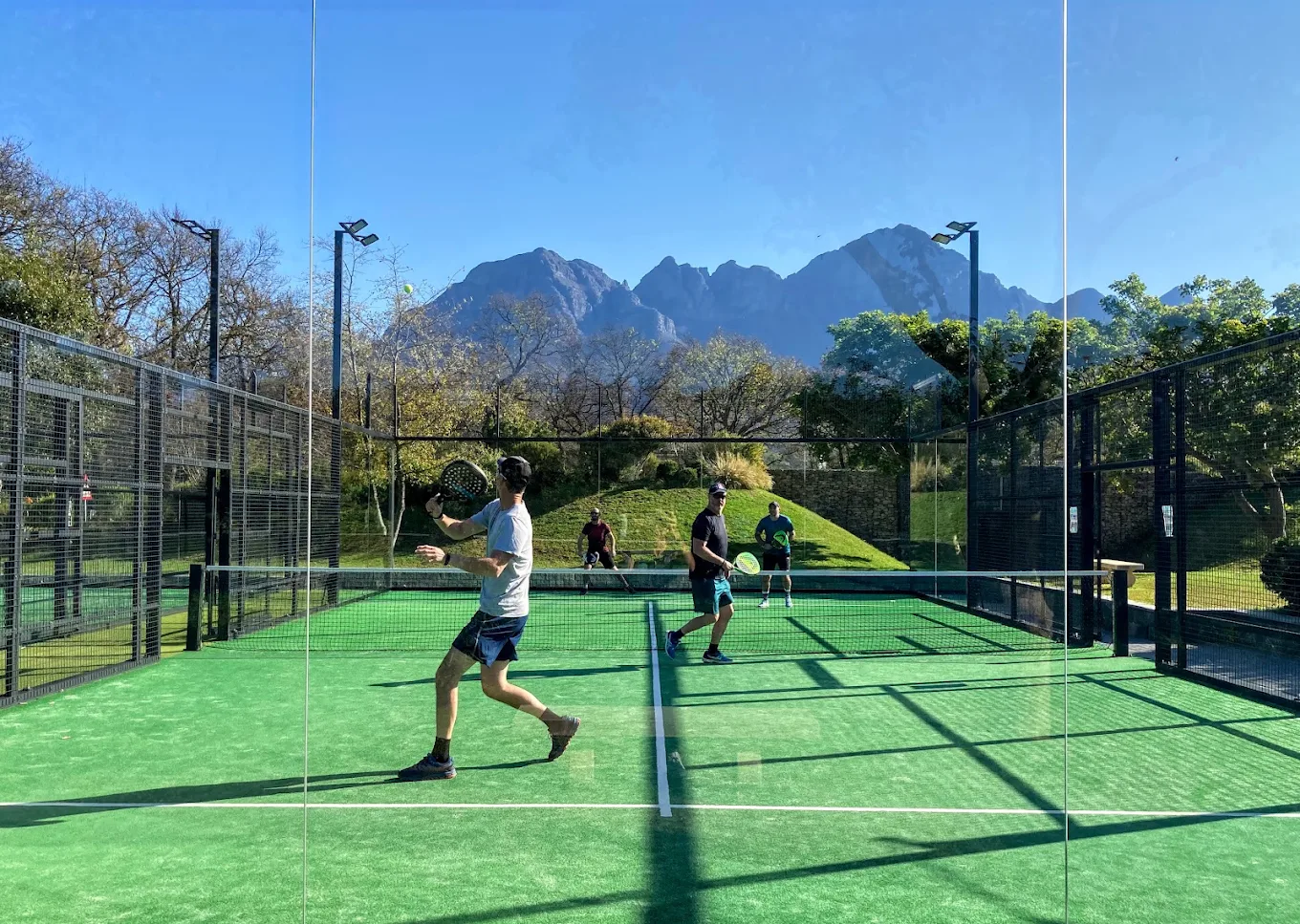
Ask yourself: where else can you finish a padel match and wander straight into a working wine estate, with the Helderberg mountains rising behind the net? At Virgin Active Padel Club, Lourensford, that’s just a normal Tuesday. Tucked inside the Lourensford Wine Estate in Somerset West, it’s one of the most scenic padel venues in the Cape — and one of the home clubs Cup Series teams can choose at registration.
It’s also proof that a Cup Series fixture doesn’t have to be a quick in-and-out. Between the vineyards, the gardens and the estate’s own markets and restaurants, Lourensford is set up for a full day out — bring the team, bring the family, and make an afternoon of it.
Where to find it
The club sits on the Lourensford Wine Estate off Lourensford Road, Somerset West, inside the same gates as the estate’s markets, restaurants and wine tasting rooms. You can reach them directly on +27 82 895 2100, which doubles as their WhatsApp number, or by email at lourensford@virginactivepadelclub.co.za. They post regularly on Instagram and Facebook if you want a look at the courts before you book, and full venue and booking details live on thepadelhub.co.za. We’ve also got them listed on our own venues page.
The courts
Four padel courts sit inside the estate’s gardens, surrounded by vineyards and framed by the Helderberg range — with a fifth court under construction, so capacity keeps growing. Pickleball is also on offer. It’s genuinely one of the best backdrops of any court on our venues list. The courts are proudly South African-manufactured, built in partnership with Padel South Africa and Padel Projects, so you’re playing on a proper, well-maintained surface rather than a bolt-on court in a parking lot.
Rates and how to book
Bookings run through the Playtomic app, the same platform most Cape Town padel clubs use. Off-peak courts (6am–4pm, Monday to Friday) go for R350 per court per hour, and peak slots (5pm–10pm weekdays, plus weekends) are R450 per court per hour. Forgot your kit? Rackets and balls rent for R60 per person on site. If your team plans to use Lourensford regularly, solo membership runs R2,000 a year or R3,000 for two, and Virgin Active members get a further 20% off every booking.
Remember that Cup Series registration covers your place in the league only — court time and kit are arranged and paid for by each team directly on the day (see our rules for the full breakdown). Lourensford’s online booking through Playtomic makes that easy to sort well ahead of a fixture.
Beyond the court
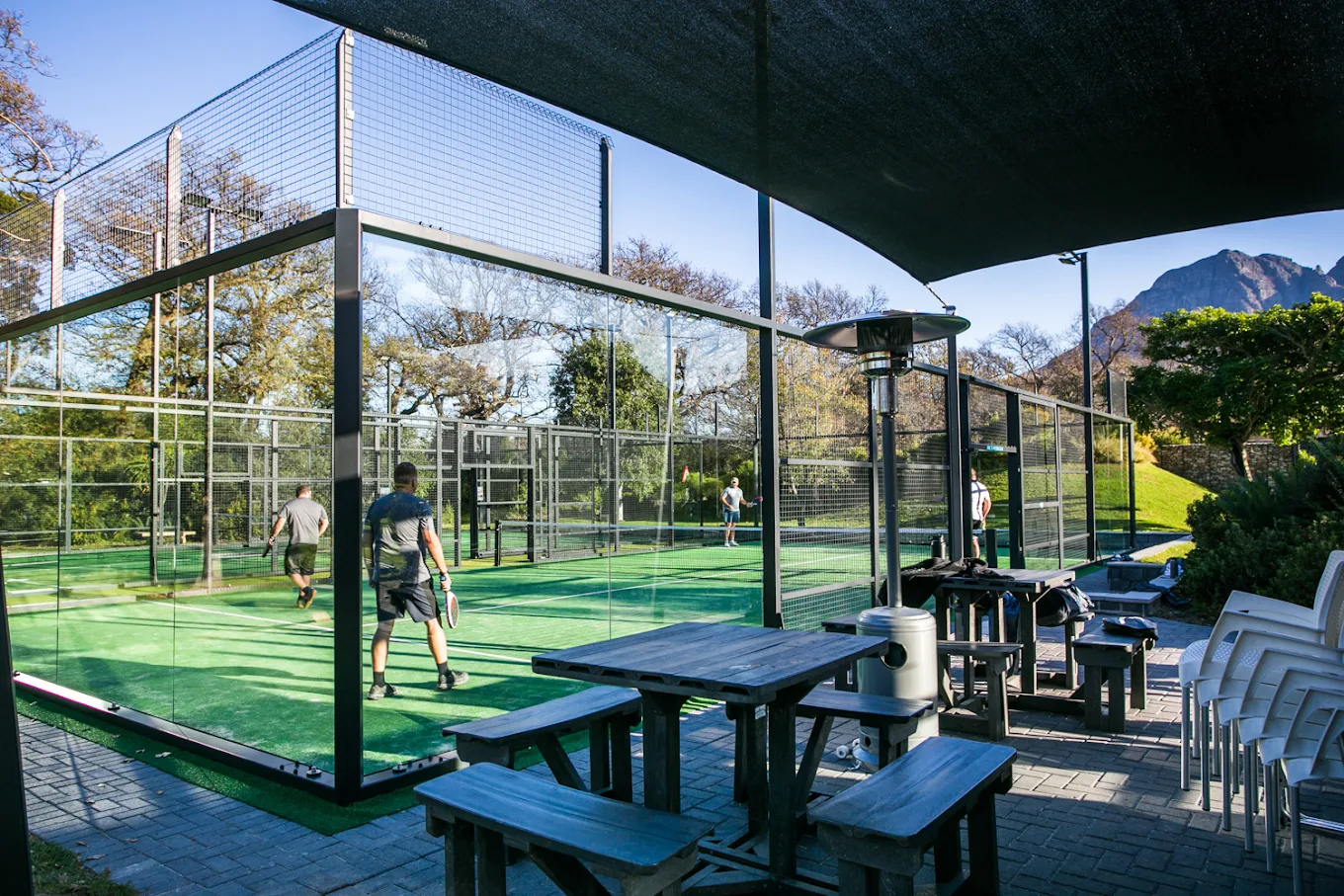
This isn’t a venue you rush in and out of. There’s a clubhouse with changing rooms, a pro shop if you need last-minute gear, and food and drinks on site — and because you’re inside a working wine estate, there’s a full day on offer beyond the four walls of a court. Grab a coffee before you play, or stick around afterwards for lunch and a glass of something from the estate.
Choosing Lourensford as your home club
When you register your team for Cup Series, you’ll nominate a home club from our full list of partner venues — and for teams based around Somerset West and the Helderberg, Lourensford is hard to beat. Head to our venues page for the complete list, or start your team’s registration on our registration page.
Register a team and you’re bought into a season with a clear shape: six divisions, a fixture list built for you, and a Finals Weekend to chase. Here’s exactly how the Bear Digital Cup Series works, from registration to trophy.
Six divisions, built around your rating
The league splits into six competitive divisions — three men’s, three women’s — each banded by Playtomic rating so teams meet opponents genuinely close to their level: Social (2.5 to 3.5), Challenger (3.5 to 4.5) and Premier (4.5 and up). Each division carries up to 10 teams, and every team registers a squad of four players plus a designated Team Owner, who handles registration, home venue, kit and branding, sponsors, and stays the team’s main point of contact with Cup Series Admin.
A season built for you, not around you
Cup Series Admin organises and manages every official fixture. Once your team selects a home club at registration, Admin builds the full round-robin schedule — every team in your division plays every other team once — and publishes the date, time and venue for every match well ahead of the season. You don’t chase opponents to arrange fixtures yourself; the schedule is set before a ball is hit.
What Admin handles, and what’s on your team
Admin takes care of the divisions, the fixture list, the standings and Finals Weekend. Your team takes care of turning up: booking and paying for your own court at the scheduled home venue ahead of each match, and sorting your own kit. Registration covers your place in the season and at Finals Weekend — it doesn’t include court time or equipment, so budget for those separately once your fixtures are set.
Wins are worth 3 league points, losses 0, and standings are settled by games difference, then games for, then head-to-head if teams finish level.
The road to Finals Weekend
After the regular season, the top 4 teams in each division qualify for the knockout stage: 1st plays 4th, 2nd plays 3rd, and the winners meet in the Division Final. Finish higher on the table and you’re rewarded with the easier semi-final draw.
Any of a team’s four registered players can represent them during Finals Weekend — there’s no minimum regular-season appearance requirement, and squads can be rotated throughout the competition as the Team Owner sees fit.
Prize money across every division
The Bear Digital Cup Series pays out R130,000 in total across the six division champions:
Fair play, from registration to the final point
Cup Series is competitive, but it runs on respect — for opponents, venues, officials, sponsors and Admin. Abusive behaviour, deliberate cheating or repeated misconduct can mean warnings, point deductions, match forfeiture or removal from the competition, and Cup Series Admin retains final authority over how the rules are applied.
That’s the structure. Now it’s about getting your four players and a home venue locked in — register your team and we’ll take care of the rest.


When you register a team for Cup Series, one number decides more than anything else which division you’ll be competing in: your Playtomic rating. It’s the same system used across the growing Cape Town scene — including by the players ranked at Padel4Good’s community tournaments — so it’s worth understanding properly before you register.
What is a Playtomic rating?
Playtomic rates every player on a scale from 0 to 7, with 7 being the highest level. It’s a dynamic rating: it moves as you play, calculated from your match results and the strength of the opponents you beat or lose to. A string of wins against stronger players pushes it up quickly; losses to weaker opponents pull it down. It’s designed to answer one practical question — who can you actually compete with on court — rather than reward how long you’ve been playing.
What the bands actually mean
In practice, players and clubs group the scale into rough skill bands. They’re not official Playtomic categories, but they’re widely used because they’re accurate:
How Cup Series uses it
Cup Series splits every gender into three divisions — Social (2.5 to 3.5), Challenger (3.5 to 4.5) and Premier (4.5 and up) — using exactly this scale. The goal is simple: a team shouldn’t find itself facing opponents a full level above or below its own. A useful sense-check when you’re rating yourself honestly is that a genuine 3.5 wins roughly half their matches against other 3.5s — if that sounds about right for you, you’re probably rated correctly.
Getting an accurate rating before you register
Because the rating is calculated from your match history, it’s only useful if you have one. A handful of ranked matches on Playtomic before you register gives you and your teammates a number that actually reflects how you play, rather than a guess. It also means less risk of your team landing in the wrong division once the season starts — which is more fun for everyone on court, not just you.
Getting your first rating without a match history
If you’ve never used Playtomic before, don’t guess blind. The fastest way to get a real number is to play a handful of casual, logged matches before you register — most partner clubs, including Padel X in Somerset West and the other clubs on our venues page, run open sessions and socials where results get logged through the app. A few matches against players you’d expect to beat, split with, and lose to will settle your rating faster than months of unranked hitting.
If logged matches genuinely aren’t an option before registration, be honest rather than optimistic: rate yourself against the band descriptions above, not against how you’d like to play. A team that under-rates a strong player tends to find itself outclassing an entire division, which is no fun for anyone on the other side of the net — and a squad that’s rated too high just spends the season chasing scores it can’t catch.
Not sure which division your squad belongs in once you’ve got your ratings sorted? The team registration page walks you through it, our guide to how Cup Series works covers the full season format, and our FAQs on the homepage cover the most common questions about division fit.

Padel has quietly become one of the fastest-growing sports in South Africa, and nowhere is the shift more visible than in Cape Town. Five years ago the city had a handful of courts and a few hundred curious hitters. Today it’s ranked tournaments, fully booked peak-hour slots, and a competitive scene deep enough to support a proper team league.
The numbers behind the hype
South Africa’s padel infrastructure has grown from a single court in 2019 to somewhere between 600 and 900+ courts across roughly 300 clubs nationwide, with an estimated 100,000 active players, according to 2025 reporting from Daily Maverick and The Debrief Network. Globally, the sport has crossed 35 million active players according to the FIP World Padel Report 2025, with more than 2,500 new courts built worldwide in 2023 alone — roughly one new club opening every week.
Cape Town’s growing scene
The city’s competitive core is centred on clubs like Africa Padel at the V&A Waterfront, Action Padel in Century City, and Africa Padel in Camps Bay. Community programmes matter just as much to the sport’s growth — Padel4Good ran a full 2025 season of men’s, women’s and mixed tournaments, closing the year with a final event featuring players ranked 2–5 on Playtomic, and posted its highest annual charitable donations yet. It has three new initiatives planned for 2026.
Who’s playing
Nationally, participation is split almost evenly between men and women, with the strongest engagement among players aged 35–44. Much of the court growth is being driven by property groups: Balwin Properties now runs padel facilities across estates including Thaba Eco Estate in Johannesburg and Munyaka in Waterfall — home to South Africa’s newest indoor court, opened in September 2025 — with further courts already arriving in the Western Cape — including Somerset West’s own indoor facility, Padel X. Grassroots operators like Africa Padel are doing the parallel work of getting complete beginners onto a court for the first time.
Somerset West’s own padel boom
The growth isn’t confined to the city bowl and northern suburbs. Somerset West and the wider Helderberg basin now have their own indoor courts at Padel X, alongside partner clubs stretching from Stellenbosch to Paarl and into the southern and northern suburbs — Club Padel and Africa Padel Van Der Stel in Stellenbosch, Africa Padel Claremont, Action Padel Century City, Padel Ace in Paarl and more, all listed on our venues page. For a league built around the Helderberg, that local depth matters — it’s what lets Cup Series offer a genuine choice of home club within easy reach of Somerset West, rather than forcing every team onto the same single court.
Where Cup Series fits in
A scene this size needs more than casual hitting sessions and one-off tournaments — it needs a structured, season-long competition that gives teams somewhere to aim for. That’s the gap Cup Series is built to fill in Cape Town: divisions banded by rating so a newer Social-division team and a seasoned Premier-division side are never mismatched, a round-robin season where every team plays every other team once, and a Finals Weekend with real prize money on the line. As padel keeps growing across the city, we want Cup Series to be the competitive home for the teams riding that wave — register your team to get involved.